
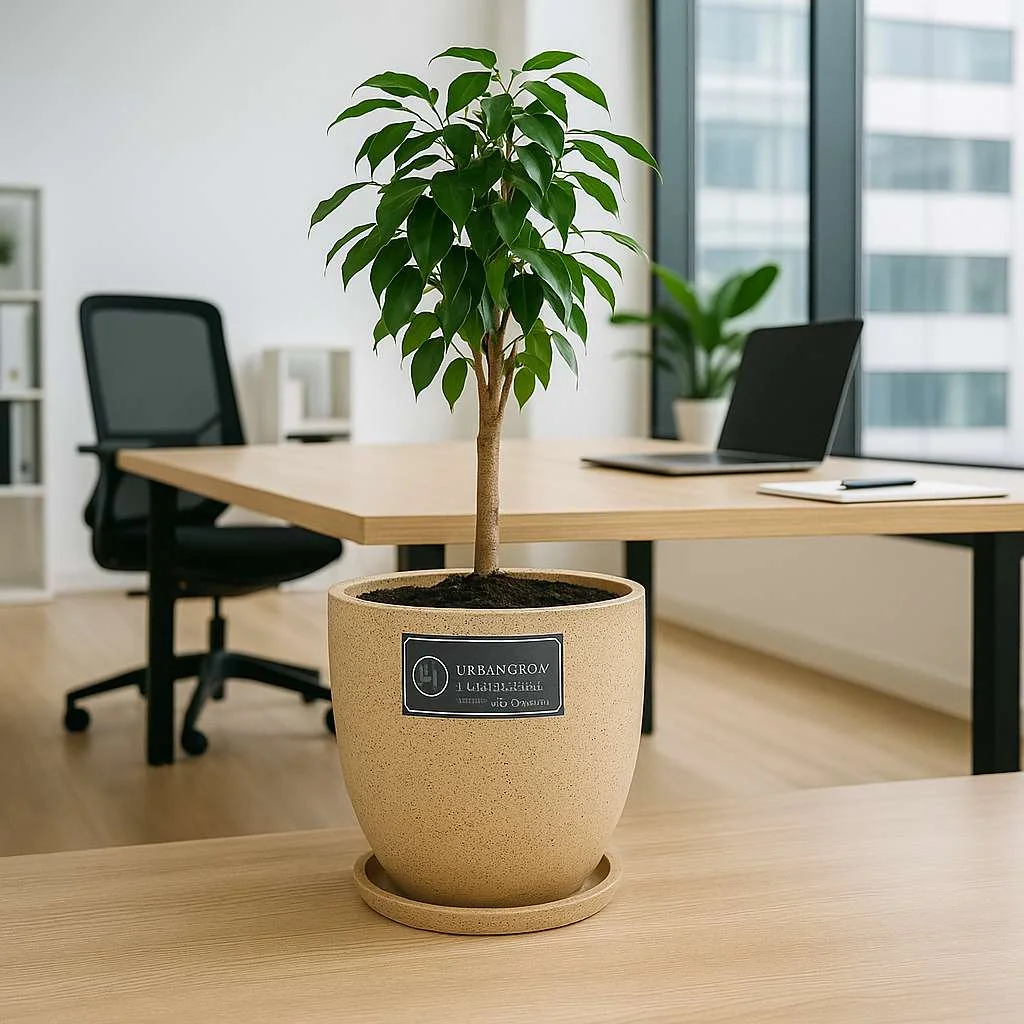
A balcony planter has to solve three problems a garden planter never faces: weight on a structure, water with nowhere to soak away, and wind. Get those right and almost any plant will grow; get them wrong and the pot either cracks, stains the floor or blows over.
How much does a filled planter weigh?
Far more than most people expect, and the weight is what decides how many pots a balcony can carry. Potting mix weighs roughly 1.3 to 1.6 kg per litre once it has been watered. So a 20 litre planter — a common size for a small shrub — sits at about 25 to 30 kg wet, before the plant itself.
Three of those along a railing is the better part of 90 kg in one line. That is usually fine on a concrete balcony, but it is worth spreading pots out rather than grouping them all at the edge, and worth knowing the number before buying six large planters at once.
This is the single biggest practical argument for plastic over cement or ceramic in a balcony: the pot itself adds almost nothing. An empty plastic planter of this size weighs a couple of kilograms where a cement one of the same volume can weigh twenty.
How deep does the pot need to be?
Depth matters more than width for most balcony plants, because roots go down before they spread.
- Herbs, succulents, seasonal flowers — 15 to 20 cm deep is enough.
- Chillies, tomatoes, small ornamentals — 25 to 30 cm.
- Shrubs, young palms, bamboo — 35 cm and above, and the wider the better for stability.
A pot that is too shallow dries out by midday in summer, which is the usual reason balcony plants fail in May and June rather than any problem with the soil.
Where does the water go?
On a balcony this is not a small question. Water that runs straight onto tiles leaves mineral staining, and water that drips onto the flat below causes arguments.
A planter with drainage holes needs a tray or saucer under it. A tray also lets the pot hold a small reserve the plant can draw on through the afternoon. What a tray must not do is stay permanently full — standing water suffocates roots, and in a Delhi summer it breeds mosquitoes within days. Empty it, or tip it, after heavy watering.
Self-watering planters solve this differently, with a reservoir separated from the soil, and they suit anyone who waters irregularly or travels.
Does wind matter on a high balcony?
Yes, and it is underestimated. Wind speed rises with height, and a tall plant in a light pot acts as a sail. The fix is weight at the bottom: a layer of gravel or coarse sand in the base of a tall planter lowers its centre of gravity without affecting drainage. Tall, narrow pots are the ones that go over; wide-based shapes stay put.
Does the colour of the pot change anything?
It changes root temperature. A dark pot in direct afternoon sun runs noticeably hotter than a pale one, and on a west-facing balcony that heat reaches the roots rather than being buffered by surrounding earth as it would be in a garden bed. For a balcony that takes the full afternoon, lighter colours are the safer choice; for a shaded or north-facing one it makes little difference and you can pick on looks alone.
What matters either way is whether the colour is UV-stabilised. Pots that are not fade within a season or two of Indian sun, and faded plastic also turns brittle.
A short checklist
- Work out the filled weight before buying in quantity.
- Match depth to the plant, not to the space.
- Put a tray under every pot, and empty it.
- Weight the base of anything tall.
- Pale colours for a sun-facing balcony, UV-stabilised whatever the colour.
Urban Grow makes planters in the sizes and shapes these conditions call for, moulded in UV-stabilised, recyclable material at our Delhi works. Tell us the balcony and what you want to grow, and we will suggest the size.